Learn, read, write and pronounce Mandarin by drawing stroke order in Anki — with HSK 1–9 audio, pinyin tone colors and a browser-based deck generator.
🔗 krmanik.github.io/Anki-xiehanzi
Works in Anki Desktop, AnkiDroid and AnkiMobile.
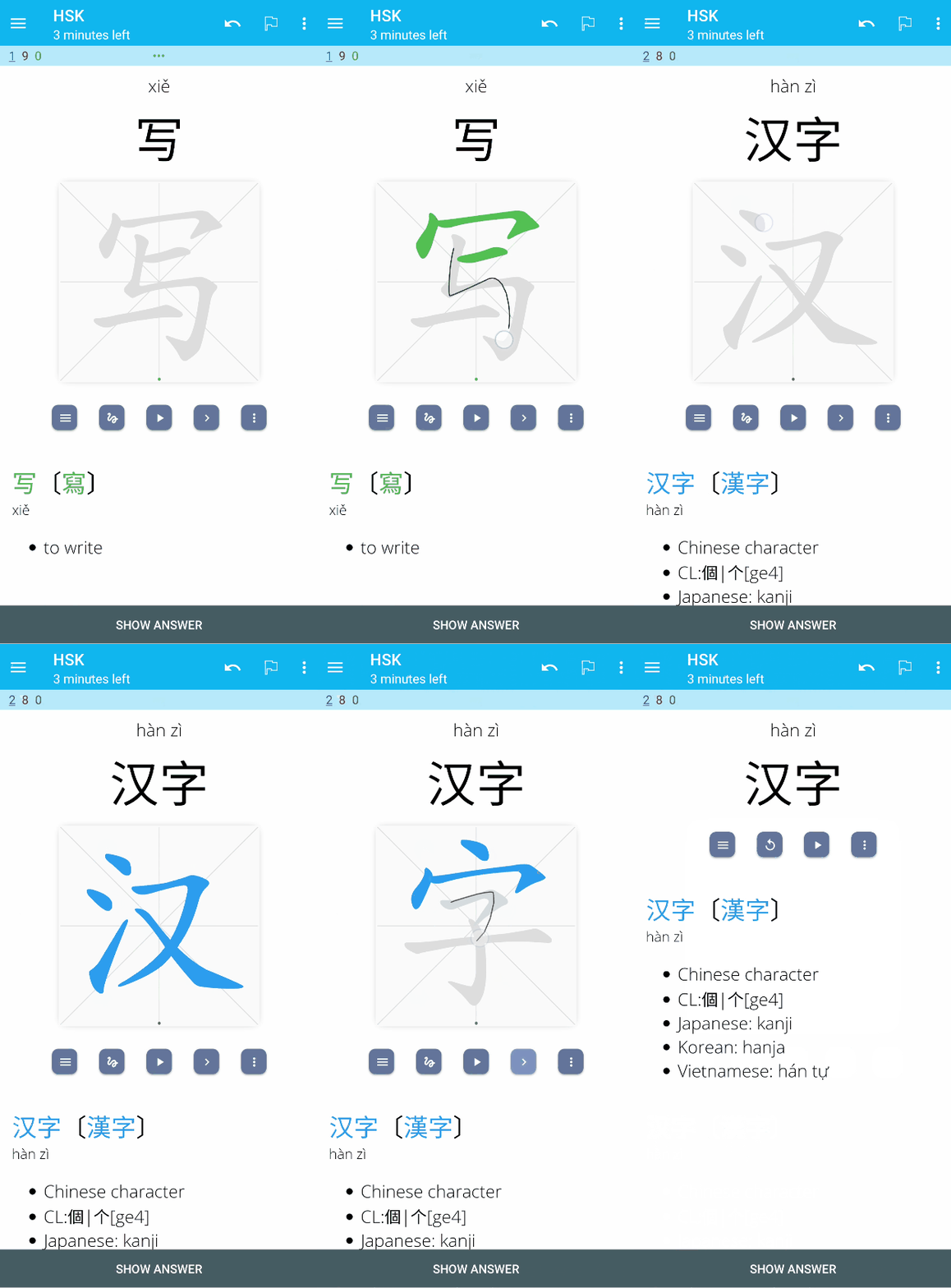
- Download a ready-made deck — New HSK (2025) covering HSK 3.0 levels 1–9. See below.
- Build your own — the Create
tool turns any Chinese words into a custom
.apkg, in your browser, no account or upload.
Browse every HSK word list —
Old HSK (2012) levels 1–6 and New HSK 3.0 (2025) levels 1–9 — with tone-coloured
hanzi and pinyin, zhuyin, traditional forms, part of speech, classifiers and
frequency. Any level downloads free as CSV, Excel, Word, PDF, plain text or JSON
— and each list has one ready-made Anki deck: a single .apkg with every level
as a subdeck, audio, example sentences and stroke order already inside, nothing
to generate in your browser.
Premium decks and extras are available at the Patreon shop.
Every deck is on the HSK page — one file per word list, one click:
- New HSK 2025 — 8.4 MB, 10,900 words, levels 1–7/9.
- Old HSK 2012 — 7.0 MB, 4,992 words, levels 1–6.
Every level is a subdeck of the one import, so a level can still be studied or suspended on its own. Each word is one note and one card: hanzi and native audio on the front; traditional form, tone-marked pinyin, zhuyin, common meaning, full CC-CEDICT definitions, character breakdown, radical, part of speech, HSK band, frequency, example sentences and a stroke-practice grid on the back. The card's sidebar switches any field on or off, and the stroke data ships in the deck, so it all works offline.
Separate writing cards, a redesigned card layout and a built-in offline dictionary are in the premium deck.
The previous version (v2.3) — four card types per level, from the legacy main.ipynb pipeline —
is still a direct download:
New HSK (2025)
·
with sentences
Import via File → Import in Anki.
Warning
Make a backup of your collection (with scheduling information) before importing.
krmanik.github.io/Anki-xiehanzi/create
Generate a deck from typed words, pasted paragraphs, an uploaded file, or a full
HSK / BCT / YCT level. The tool segments the text, looks up each word in
CC-CEDICT, lets you customize card types, fields and appearance with a live
preview, then exports a self-contained .apkg (audio, fonts and stroke data
bundled — works offline once imported). Everything runs client-side.
See Export a Deck for the walkthrough.
- Draw and practice stroke order (powered by Hanzi Writer)
- Simplified and traditional characters
- Pinyin (tone-marked) and Zhuyin (Bopomofo), with tone colors
- Colored strokes and characters
- HSK 1–9 audio plus text-to-speech
- CC-CEDICT definitions, part of speech, radical, breakdown, HSK level and frequency
- Smart example sentences
- Night mode; adjustable character size and stroke width
- Show / hide Simplified, Traditional, Pinyin or Meaning per card
- Decks sorted in frequency order
- External lookups: Pleco, HanziCraft, mnemonics
- Load indicator at the bottom (
green = loaded, red = error / not loaded)
Some setting changes take effect on the next card.
View the docs — features, studying tips, exporting a deck, and FAQ.
Note
The old (v1) version of the site is still available at krmanik.github.io/Anki-xiehanzi/v1. It is archived for reference and no longer updated.
Previous decks (2021-03) — five legacy types, click to view
Separate decks for each type:
- Stroke order
- Meaning
- Pinyin / Zhuyin
- Pronunciation (audio + Pinyin / Zhuyin)
Sorted in frequency order. Download
Five card types per HSK-level note: stroke order, meaning, pinyin/zhuyin, pronunciation, tone marks.
Sorted in frequency order. Download
Same five card types as Type 2, but sorted in alphabetical pinyin order.
Not frequency-sorted. Download
Single note type — front: pinyin + meaning; back: writing component.
Not frequency-sorted. Download
HSK 2.0 deck.
Not frequency-sorted. Download
Stroke drawing uses the Hanzi Writer JavaScript library. Its character and stroke-order data is derived from Make Me a Hanzi.
This is a JavaScript implementation that works because Anki renders flashcards in a webview. It may not work on every device. Make backups (with scheduling information) before importing. Some audio files are missing; they can be regenerated with text-to-speech using gtts-textToMp3.
See CONTRIBUTING.md or the Contributing docs page. Wrong word, pinyin or meaning? Those live in the HSK-3.0-words-list submodule — fix them there.
More decks by the author: AnkiWeb.
Author: Mani (krmanik). MIT License and GPL 3.0. Third-party licenses: License.md.
Part of the code in this project was generated with AI (Claude Opus 4.8).